
Hello there! Happy October. Not much big news to report, other than I’m sure ready for this election to be over. Moving on!
Over the last few months, I’ve been enjoying a delightful game: Ticket to Ride Legacy: Legends of the West. I’ve always liked the Ticket to Ride games. They’re family-friendly, easy to learn, and quietly reward people who love geography. The new legacy version elevates a nice, light-weight board game into an narrative experience that spins a story of railroads expanding westward across America. We’re going to play our 12th and final game in the legacy campaign soon, and I can’t wait to see how it all turns out!
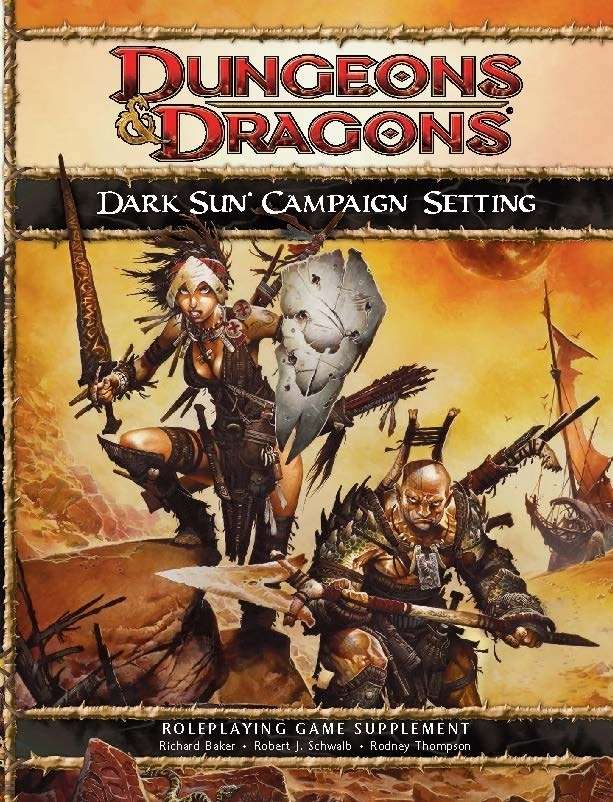
Anyway, this week I’m back with another look at the story of D&D and my own part in it across four editions of the game. Today’s topic: the 4th Edition Dark Sun Campaign Setting.
Dark Sun 4th Edition
I first encountered the barren desert world of Athas, home of the Dark Sun campaign setting, a few weeks before I got hired as a game designer at TSR in the fall of 1991. I fell in love with the setting immediately. A D&D world that mashed up Conan the Barbarian, John Carter of Mars, and any number of cheesy sword-and-sandal fantasy movies? I was all in!
I wasn’t part of the original Dark Sun design team, of course. The boxed set was published right before I started at TSR–the credit belongs to Tim Brown and Troy Denning. But as a rookie designer, I was assigned to TSR’s “New Worlds” product team, so I got the chance to work on the Dark Sun product line almost immediately.
In my first couple of years with TSR, I wrote Valley of Dust and Fire (not great, sorry, I was still learning), Merchant House of Amketch, Dragon’s Crown, and The Will and the Way. In time, I moved on to other projects, and during 3rd Edition Dark Sun went dormant for a long time. I missed Athas, but in the back of my mind I always hoped we would return to Dark Sun.
Fast forward a dozen years and two editions, and the time for Dark Sun’s return finally came around. In 2009, I was assigned as lead designer and team leader for the 4th Edition version of this beloved campaign setting. Alongside fellow designers Bruce Cordell, Rob Schwalb, Rodney Thompson, Logan Bonner, Ari Marmell, and Chris Sims, I got to revisit Dark Sun through the lens of an entirely new edition of the game.
One of the first things we realized was that 4E gave us some really useful tools for shaping the setting. By 2009, 4E had defined a number of different “power sources” for D&D characters: martial, arcane, divine, primal, and psionic. Because a character’s role in the party was based on class, not power source, we had an interesting new way to say “these heroes are found in this world, and those heroes aren’t.” For example, the 2E Dark Sun didn’t have clerics or paladins (it had elemental clerics instead). But what if we looked at Athas as a world that didn’t have a divine power source at all? Presto, no clerics! You want a healer in the party, play a warlord or build an empath.
Of course, that led to the question of why a world wouldn’t have divine power, which suggested an epic new spin on the Dark Sun story: this was a world where the gods lost their ancient war with the titans. (Metal AF, if you ask me!) It was a big, bold new take on a beloved setting. However, the biggest idea in Dark Sun 4E was the introduction of character themes.
In previous blogs I mentioned Project SCRAMJET, the team we assigned to examine the narrative elements of D&D while we were working on the mechanics of the new edition. While SCRAMJET revised and expanded many things about the game’s story, we spent weeks looking for a “third pillar” of character identity. We hoped to nail down something that would carry as much weight for your character as race and class. If you were a half-elf ranger, that told you a lot about your character. But could we come up with something else to make you an [[X]] half-elf ranger, where X was something that had both mechanical and story weight? Not to be crass about it, but something we could sell to players to inspire new generations of character-building?
Well, we considered some crazy “third pillar” ideas in SCRAMJET. Two that I remember: patron deity, and alignment. Yes, we kicked around the idea of just leaning full-on into alignment and making it big, really big, part of every character build. But we never felt we could pull the trigger on any of those ideas, so we dropped the quest for the third pillar . . . until 4E Dark Sun came along.
In looking at how to update the original 2E Dark Sun character options, I realized that a couple of the character classes were odd fits in our power-source scheme. The Gladiator class was always an odd duck, because you’d want any fighter, barbarian, or ranger to be a viable choice as an arena-fighter. “Gladiator” was something characters should be able to do without regard for their base class. It shouldn’t be a class, it was more like a 2E character kit. Likewise, the Templar class seemed to tell the story of a social station or political rank—and we didn’t want a divine caster, anyway.
I chewed on that challenge for a bit, and the light bulb finally went off. We needed to return to the 2E idea of the character kit, and make it something that truly cut across character classes. Add in some mechanical weight so you would feel like an [[X]] in every encounter, and we would not only fix the challenges of the Dark Sun characters—we would finally have an answer to that “third pillar” question that stumped us at the beginning of 4E.
And so, character themes made their way into D&D halfway through 4E. I wish we’d thought of them sooner!
Did Dark Sun stick around into the 5E era? No–not yet, anyway. Of course, countless thousands of D&D players have played in a Dark Sun game at some point, and many home campaigns of Dark Sun are still running out there, I’m sure. But at the moment, the official Dark Sun setting is lying fallow again. It hasn’t yet appeared in 5th Edition. But I certainly returned to the notion of character themes and ran with it in my Primeval Thule setting, which includes a 5E version. And the 5E take on character backgrounds traces at least a little of its lineage to what we did with Dark Sun’s character themes, or so I think.
I can’t wait to see what Dark Sun looks like when it comes back!
 Richard Baker
Rich,
Thanks for the ride down memory lane with Dark Sun. Continues to be my favorite setting to this day. We’re running fan versions of 5E Dark Sun and introducing new players to this awesome setting.
KEEP HOPE ALIVE!
June Soler
LikeLike
Great blog Rich – thanks! We ran through Merchant House of Amketch earlier this year in our streamed game and loved it – such a great adventure. Did Dragon’s Crown and Valley of Dust and Fire last year (don’t apologise for Valley – it’s awesome!). Dragon’s Crown took us 16 sessions – a blast from start to finish.
Love the Themes in 4e – in a nice “circle of life” I’ve adapted several of them back into kits for 2e haha. Great stuff.
LikeLiked by 1 person
Dark Sun was my favorite 2E setting, and Dragon’s Crown produced a lot of great memories. Then it coming back for 4E was much appreciated by me. Sadly the one campaign we had floundered, but as I delve back into 4E I may return to the desert.
Themes were a great way of incorporating a lot of Dark Sun’s parts that didn’t seem to fit quite right in 2e. Nice job on that!
LikeLike