
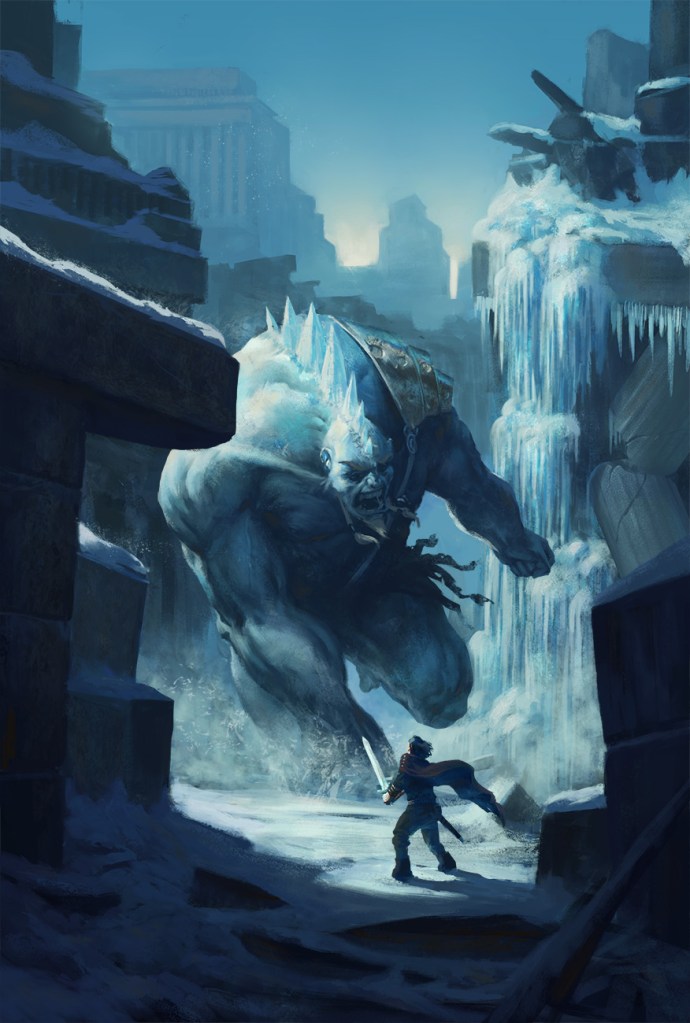
Hello! Our D&D golden jubilee year is drawing to a close. The World Series is over, peak autumn foliage has come and gone outside my window, and our travel plans for Thanksgiving and Christmas are all but settled. As you might expect, I have some thoughts about the election, but I’ll keep them to myself.
I have just one more of my retrospectives planned for 2024 after today’s entry. That one’s kind of a no-brainer, really. (Hint: it rhymes with Man Shelver.) But before we leave the Pathfinder/4E era behind, I’ve got one more entry: Primeval Thule!
Primeval Thule Campaign Setting
If you’re familiar with my career, you probably know that in December of 2011, Wizards of the Coast decided they could no longer afford to retain my services. After 20 years of working on D&D as an in-house designer, I was out. The team was downsizing, I was in a weird team-lead/low-management position, and I suspect the powers-that-be didn’t feel like sharing the vision for the new edition or wrestling with me for the steering wheel. (I think I would have shared just fine, but whatever.)
Anyway, for the first time in 20 years, I was in the position of being free to work on anything I wanted to while I tried new things. About a year after parting ways from WotC, Ryan Dancey reached out and asked me to help him with his Pathfinder Online Kickstarter. (I know that didn’t work out the way people hoped, but I think Ryan had an interesting business case and it could have been something good. It just wasn’t really Pathfinder.) That was the first time I’d really taken a close look at crowdfunding, and I realized that you didn’t have to be a big RPG publisher to produce a high-quality RPG book and get it in front of an audience.
The other thing that working at Goblinworks gave me was time to think. My commute to Redmond was about 70 minutes each way. I entertained myself by imagining cool things I’d like to write. And I started thinking about D&D worlds or fantasy sub-genres I wanted to see. I’ve always loved Clark Ashton Smith’s Hyperborea stories, and that was my springboard. Incorporating the inspiration of Robert E. Howard’s Hyborian Age was an easy next step. And then sprinkling the D&D-isms to support a tabletop RPG rounded out the vision. Primeval Thule was born in those long, long drives through the Cascade foothills and along the shores of Lake Sammamish.
I knew it would be a lot of work, so I reached out to a couple of good friends and former WotC teammates, Steve Schubert and Dave Noonan. In true D&D fashion, I summoned them to a secret meeting in a local tavern and unveiled my plan. Thus, Sasquatch Game Studio came to be.
Naturally Dave and Steve had plenty of ideas of their own, and we began to seriously iterate on the initial Thule pitch. Perhaps the biggest, craziest idea we landed on was the idea of building Primeval Thule as a multi-system setting. In the RPG business, it’s pretty commonplace to create one game system (say, D&D 3rd Edition, or GURPS, or Savage Worlds), and then publish several different settings that share those rules. We decided to perform the experiment of doing things the other way around: to create one setting, and publish it for several different game systems. For our first take on Thule, we chose Pathfinder, 4th Edition Dungeons & Dragons, and the new 13th Age game system. All had pretty generous game licensing available, and we had a ton of personal design experience applicable to each one.
While our plans were moving ahead, we were busy designing and writing a new game world. Dave created that crunchy, crunchy poster map with a thousand tags inviting adventure. Steve gave us a solid development pass and made sure we delivered a balanced, playable product—and, even more important, he took on the challenging task of figuring out how to organize as a small business and volunteered his house as Sasquatch HQ. I wrote big hunks of the book and also took on the role of art director. I recruited illustrators like Todd Lockwood, Klaus Pillon, Claudio Pozas, Justin Mayhew, and Chris West to give us a beautifully illustrated book.
We Kickstarted Primeval Thule in 2013, and learned some important lessons. Like, it’s much better to go with a low target and blast through stretch goals than to just state the amount you think you really need and not succeed until the last couple of days. But succeed we did (with a bit of help from some friends). Later on, we ran a second Thule Kickstarter for a 5E version of the setting, and that went much smoother. And after that, we made a deal with the guys at Evil Beagle Games for a Savage Worlds conversion of the setting, so Primeval Thule has the distinction of being a RPG setting available in no less than five different game systems.
I’m sorry to say our grand plan to absorb a horde of disaffected 4E fans upset about WotC abandoning their game system didn’t really work. I love the 4E version of Thule—I think it’s the best system for the setting, really—but it only sold a couple of hundred copies. Our 13th Age version didn’t do any better. It would have been more profitable to stick with just the Pathfinder and 5E versions. But that’s the beauty of being a small-press company: You can perform experiments a bigger publisher would never commit to trying.
If you’re curious, Thule is still available at DriveThruRPG. Check it out if you like!
So, what did Primeval Thule contribute to the zeitgeist of 50 years of Dungeons & Dragons? Of all the things I’ve talked about this last year, Thule is by far the smallest in numbers. Maybe 5,000 copies of physical books in various editions are out there in the universe, plus a similar number of PDF sales. Everything else I’ve touched in this blog series sold at least ten to twenty times as many units, and therefore reached many more players. But Thule persists as a hidden gem of sorts, a setting beloved by a small number of discriminating fans. Even today, you can find people starting up Thule games in various virtual tabletops and online meetup groups.
I guess I consider Primeval Thule important to *me*, just because it’s a world I thought up and got into print without the support of a major publisher to build the business case. Thousands of people—maybe not hundreds of thousands, but still thousands—came to a place in my imagination and had fun (or are still having fun) playing there. That’s what you become a game designer for.
Oh, and in case you’re curious: Yeah, it’s supposed to be pronounced “too-leh”. But we all just say “THOOL.”


I’m proud to say I have the Pathfinder, 4e, AND 5e D&D versions – and I have run Thule campaigns in both 5e and in Mini Six! It really is a wonderfully atmospheric and flexible setting. I had barbarian heroes searching the ice-choked ruins of B1 Palace of the Silver Princess in the Claws of Imystrahl before Argenta’s realm vanished forever beneath the endless glaciers. Who *was* that mysterious Atlantean dragon-riding knight?!
LikeLike