
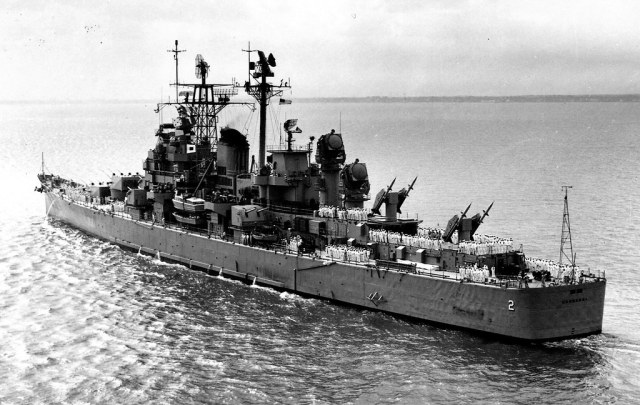
(Pictured above: USS Boston, CAG-1)
Welcome back! Last time, I took a look at the “Trump battleship” announcement and why the USS Defiant proposal isn’t a “battleship” per se. I felt that it was important to set people straight, since criticism of a 1940-era battleship design is frankly irrelevant to a discussion of whether building Defiant-class large missile cruisers is a good idea or not.
However, that did get me thinking: Is it even possible to build a true battleship these days? What would it look like? Would it be obsolete, or not?
Defining the Old Battleship: Guns, Armor, Speed
A World War II-era battleship was designed to wreck enemy ships with powerful guns. It was meant to take damage and keep on fighting. And it required enough speed to keep up with the fleet and bring the enemy to battle.
Generally speaking, navies had to settle for emphasizing two traits and skimping on the third. Old American battleships (the “Battleship Row” of Pearl Harbor) sacrificed speed for powerful guns and thick armor. Anything with a battlecruiser heritage gave up armor to keep powerful guns and speed. And a few designs like the German Scharnhorst class went light on gunnery to favor armor and speed.
If you wanted all three traits, you had to overspend. In this case, that means building a significantly bigger ship to fit the engines, guns, and armor you wanted. So, in the late ‘30s, navies started building the modern fast battleship – ships that were generally 40,000 to 50,000 tons in place of the old 35,000-ton ships. Ships like the Bismarck, Jean Bart, Littorio, or North Carolina carried all the guns and armor of the older ships, and could make 30 knots or close to it.
(I could go into the Washington Treaty and its limitations, but that’s a not really needed for this discussion so I’ll hold off on that for now.)
This is why HMS Hood enjoyed such a reputation at the beginning of the war, even though she was twenty years old. At 46,000 tons, Hood was a good 10,000 tons heavier than any Washington Treaty-era design, and combined the speed of a cruiser with the guns and armor (almost) of a battleship. She was the first fast battleship in a lot of ways. Pretty much any new battleship that came into service in the late ‘30s through late ‘40s likewise combined firepower, armor, and speed at the cost of a 45,000-ton-plus displacement.
A 21st Century Battleship: Firepower, Speed, Toughness
To make a ship with similar traits in 2026, we’d substitute a powerful missile battery for the heavy guns of the last century. Our modern battleship needs to hit things 200 or 300 miles away, not just 20. So let’s remove those big heavy turrets and replace them with a generous helping of missile tubes and vertical launch cells.
Speed is also just a question of expense. Enough diesels or gas turbines can push a big hull through the water if you’re willing to commit to the tonnage. Or, if we’re talking about ships in the 30,000-ton range, go nuclear. We have plenty of experience building nuclear-powered aircraft carriers and submarines, although we haven’t had a nuclear-powered surface combatant since the Virginia-class cruisers.
Armor, however, is a trickier question. We might be better off to think about resilience or toughness in other ways. I’ll dig into that below.
Armor vs. Missiles
It is absolutely possible to protect at least some of your ship against some missile hits. Take a look at the image below. It’s a famous picture of a kamikaze strike on the cruiser HMS Sussex in 1945. The kamikaze hit the cruiser directly on her armored belt—a wall of steel 4.5 inches thick. Battleships carried even heavier armor belts. USS Iowa, for example, had a belt 12 inches thick.
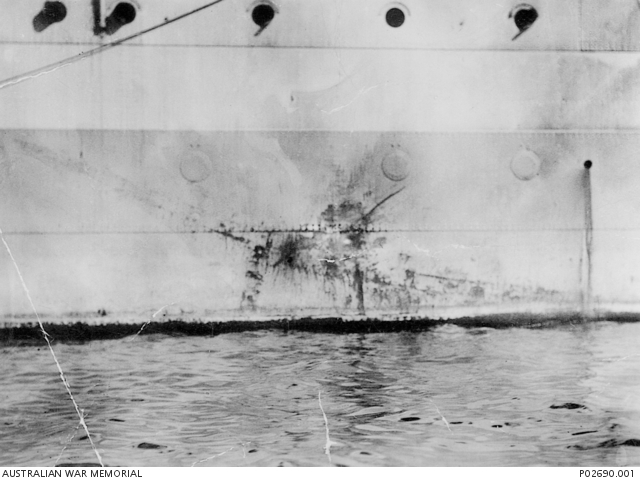
As you can see, the kamikaze failed to penetrate HMS Sussex’s armor. Likewise, British carriers in WW2 with their armored flight decks proved much more resilient against kamikaze strikes than US carriers.
A modern subsonic cruise missile is fairly comparable to a kamikaze (setting aside, of course, the tragic desperation of a pilot willing to die). Most antiship missiles carry warheads of about 500 to 1,000 pounds, about the same size as a WW2 kamikaze. They fly somewhat faster—say, 500 to 600 mph instead of 300 to 400 mph—but the comparison holds up. An armor belt of 4 to 5 inches would be pretty good protection against a Harpoon missile.
However, it’s just not practical to cover your whole ship in 5 inches of armor. The best you can do is cover critical areas like magazines, command and control spaces, and machinery rooms. A Harpoon might hit an armored spot, but it might not. And even a hit in a non-vital area can effectively “mission kill” a target by starting fires or knocking out delicate electronics, such as radar systems. The ship might be in no immediate danger of sinking, but it can’t fight effectively after it takes a hit. It has to withdraw for repair.
Then there are armor-piercing missiles.
As far back as 1943, the Germans used a guided “missile” called the Fritz X to sink the modern Italian battleship Roma. (Yes, the Fritz X was a glide bomb, but it struck with a missile-like velocity and warhead.) Two hits were sufficient to sink a ship comparable to contemporary American battleships of the time—the Roma’s heavy armor didn’t save her.
Throughout the Cold War, the Russians fielded even bigger and more dangerous anti-ship missiles intended to disable or destroy a Nimitz-class carrier with just one hit. The SS-N-12 Sandbox missiles carried by Slava-class cruisers mount 2,200-pound warheads on a Mach 3 missile—that’s a speed of over 2,000 miles per hour! It probably couldn’t penetrate the belt armor of an Iowa (missiles are more fragile than AP shells, after all), but a hit anywhere else would certainly result in major damage.
Worse yet, the Chinese are now fielding capable anti-ship ballistic missiles like the DF-21D. The best guess is that it’s maybe a 1,000-pound warhead going at Mach 5 or 6, and of course it’s striking with a very high elevation—your deck armor might help, but belt armor won’t. Trying to build an armored deck thick enough to shrug off a DF-21D is an arms race you can’t win.
Cruiser Armor: A Compromise
Given that, the heaviest reasonable armor choice for a 2026 battleship would be something comparable to a WW2-era heavy cruiser. Take a look at the picture at the top of the post. That’s USS Boston, a WW2 Baltimore-class heavy cruiser converted to a missile cruiser shortly after the war. She kept her forward gun mounts and her armor, but traded her aft turret for a missile battery. If you want a “missile battleship,” Boston and her sisters are a good comparison.
Belt and deck armor such as that carried by USS Boston could blunt at least some of the damage caused by a missile such as an Exocet or Harpoon. Good compartmentalization, machinery dispersal, and redundant systems also improve a ship’s ability to take a hit and keep fighting—although it bears repeating that a “mission kill” is the likely result of any hit by an antiship missile. Whether it could stand up to a SS-N-12 or a DF-21D is a different question. I suspect not, or we wouldn’t have stopped building armored ships.
Could we actually build an armored battleship for the 21st century? Within limits, sure. But at the end of the day, the best defense is to not get hit at all.
 Richard Baker