Hello there! Happy September. This is pretty much my favorite time of year. Baseball pennant races and playoffs, football, autumn colors and cool sunny days … yep, fall is the best.
In reading and watching news, I recently picked up Robert Heinlein’s Space Cadet for the first time in oh, about 40 years. Kind of boring, to tell the truth. My wife and I just finished the last season of Umbrella Academy, and now we’re on to the new season of Rings of Power.
(I like Rings of Power, but I wish it stayed a little closer to Tolkien canon. I’m not a purist—I was generally unoffended by most of Peter Jackson’s deviations in the film trilogy. But The Hobbit trilogy really wandered away from the source material and wasn’t better for it.)
Anyway, on to game stuff!
50 Years of D&D: The Shadowfell and the Feywild
After a long stay in the 3rd Edition era, I’m moving on to my contributions in 4th Edition. These days a lot of gamers look back on 4e and remember only the failures and missteps. I think that’s a little unfair. While there were things I wish that edition had done differently, there were many excellent features to that system.
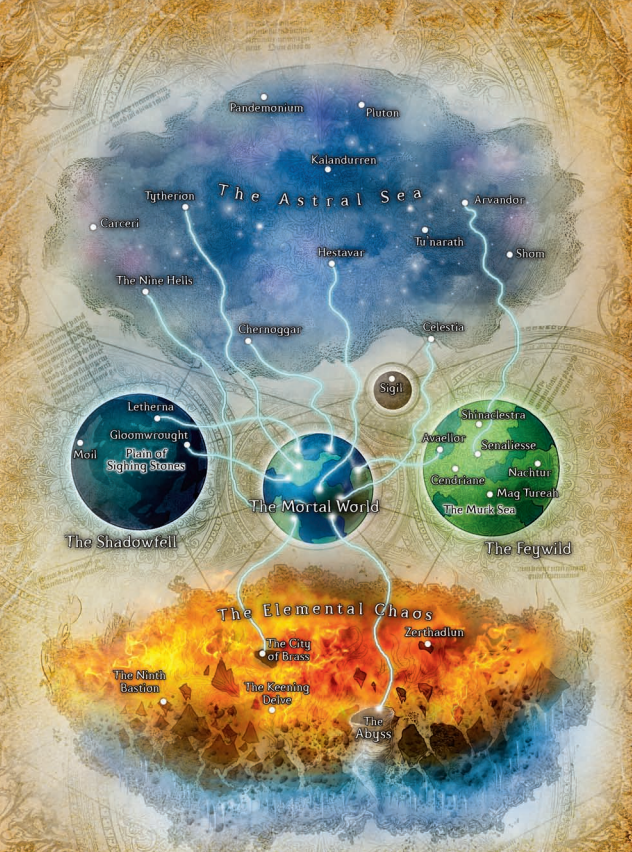
For example, 4th Edition fully established the Shadowfell and the Feywild in the game.
While the concepts of “shadow” and “faerie” are ideas that had bounced around in D&D since 1st Edition, the worldbuilding teams I spearheaded during the 4e development process took those concepts and formalized them as part of the modern game’s cosmology. For the first time, the inherent setting of the D&D game had a language of ideas to describe things like faerie-lands, the people of the hollow hills, and dark otherworlds like Earthsea’s the Dry Land or the Upside-Down.
To be clear, I’m not claiming I invented the idea of faerie or shadow in D&D (although I did come up with the names ‘Feywild’ and ‘Shadowfell’). My part in the story began with distilling and clarifying some obscure lore that had been kicking around since 1st Edition. It’s a bit of a convoluted tale, so I’ll try to sum up.
In 1st Edition, “faerie” existed mostly in the form of one-off adventures or out-of-place monsters imported from folklore. “Shadow” was mentioned as a demiplane in the 1E Manual of the Planes. It was the place illusionists traversed when they used the spell shadow walk, and the plane of origin for a handful of interesting monsters (such as shades). All before my time.
For the Birthright Campaign Setting of 2nd Edition, I came up with the Shadow World as a dark mirror of the daylight world. Once Cerilia’s realm of faerie, the Shadow World was now a dark and dangerous place haunted by the will of an evil god. In 1995, I got my first chance to write D&D novels (in the Birthright setting, naturally), and I featured the Shadow World in my book The Shadow Stone. Which then got canceled after Wizards of the Coast acquired TSR.
Well, soon after we all moved out to Seattle, book editor Peter Archer made the pitch to rewrap The Shadow Stone as a Forgotten Realms story. So, I carried out a thorough rewrite and re-framed my story in Chessenta. The Shadow World element of the story was slightly tweaked to refer to the Plane of Shadow, although it was really just a name change.
Shortly after The Shadow Stone was finally published, we began serious work on 3rd Edition D&D. Jeff Grubb took on the 3E version of the Manual of the Planes. In 3E, Jeff reimagined the Plane of Shadow as a “transitive plane” like the Astral or Ethereal. This book also introduced the idea of Faerie as a “variant plane.”
While Jeff was hard at work on the 3e Manual of the Planes, I was working with the design team for the 3e Forgotten Realms Campaign Setting. Inspired by Jeff’s “Building Your Own Cosmology” in the MotP, Skip Williams and Sean Reynolds cooked up a unique cosmology for the Realms—the “World Tree” of Realms-specific heavens and hells. Elements of the Shadow World from my novel The Shadow Stone wound up in the FRCS as the Shadow Weave. Which is where things stood until 4E came along.
After a good run of 3E, in 2005 the WotC D&D team began serious planning for the game’s 4th Edition. I was assigned to lead a 4E Forgotten Realms revision planning team consisting of Phil Athans and Bruce Cordell. During the course of our discussions, I came up with the basic idea of the “World Axis” cosmology to tidy up the messy bits of cosmology and accommodate early ideas coming out of the 4E design team, and pitched it to Phil and Bruce. In this scheme, faerie and shadow existed as parallels to the material plane, with the elemental planes “below” and the astral planes “above.”
A few months later, I ran another concept team—the SCRAMJET project (so named because the team included Stacy Longstreet, Chris Perkins, Rich Baker, Michele Carter, James Wyatt, and Ed Stark). I brought the World Axis cosmology pitch I’d worked out with Bruce and Phil to the SCRAMJET team. We debated, poked, and prodded, and the concept settled into place with the names Feywild and Shadowfell.
During the 4E era, we went on to devote whole sourcebooks to our realms of faerie and shadow: Heroes of the Feywild, Heroes of Shadow, and more. Fun ideas like the fomorians of the Feydark, the shadowy city of Gloomwrought, the deathly realm of the Raven Queen, and the archfey of the Court of Stars came to life. We even examined other D&D worlds and came up with some pretty interesting ideas for what the Feywild and Shadowfell looked like in settings like Dark Sun.
So, what remains of the Feywild and the Shadowfell in today’s game? Quite a lot, actually. 5th Edition D&D backpedaled from many of 4E’s story elements, but these two parallel worlds remain part of the assumed cosmology of the game. And both the World Tree and World Axis schemes get a nod in the 5E Dungeon Master’s Guide. I imagine they’re going to stick around a while!
 Richard Baker