
Welcome back!
I’m nearly done with the first season of 3 Body Problem, and I have to say I’m enjoying it quite a lot. Better yet, I managed to interest my wife in the show, and she got hooked too. I liked the books okay, but I think I like the Netflix show better. Somehow it just lands better in the TV format for me—usually I’m a book snob about such things.
In other news, I drove up to Pittsburgh with my friend Ed Stark last weekend to catch the Phillies playing in the Pirates’ home park, PNC Field. I think PNC Field might be my favorite baseball stadium anywhere. The Allegheny River is just past the right-field bleachers, and the view of the bridges and downtown Pittsburgh just can’t be beat. Plus, the food’s pretty good. Try the loaded pierogies if you ever go!
On the downside, I paid a lot of money and went to a lot of effort to watch the Phillies lose two games in a row. So far this season, I’ve gone to see the Phils four times, and I’m 0-4 so far. They need to pay me to stay away!
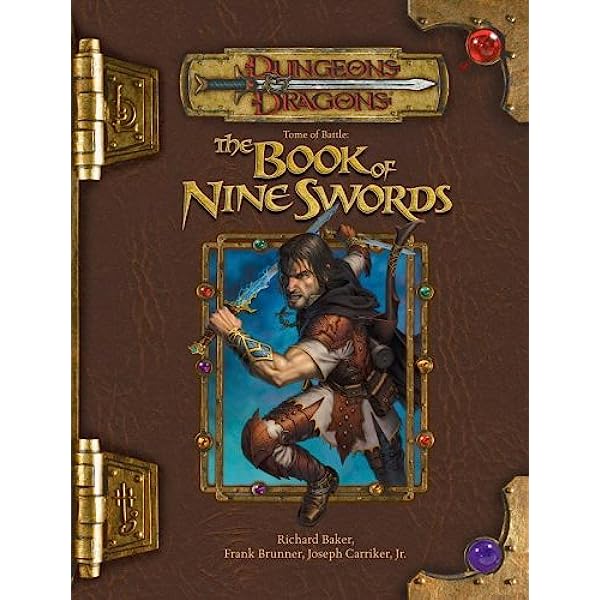
Okay, time to move on to the next entry in the list of “my favorite personal contributions to D&D.” Enter the Book of Nine Swords!
Tome of Battle: Book of Nine Swords
In a previous post, I described how the designers and editors working on D&D assembled every now and then for pitch meetings, suggesting ideas for new D&D products. One of the ideas that came up a few times in the 3rd Edition era was a rulebook pitched as “spells for fighters.”
I don’t remember who suggested it first—I know it wasn’t me. I think it was floated by several different people at various times, to be honest. I dimly recall that Bruce Cordell might have pitched it the last time we kicked it around the table, but I could be wrong. Anyway, sometime around 2004 the idea finally stuck on our proposed schedule, and I was penciled in to work on it. Thus the Book of Nine Swords came into existence.
Initially, I was lukewarm toward the idea. Throughout my time at TSR/WotC, I had earned a reputation as a designer comfortable working on “crunchy” products (crunch in this case meaning, game mechanics like new classes or rule systems). The Big Fighter Crunch Book was exactly the sort of thing one might have expected me to pitch and champion. But I didn’t really have an idea of how to implement the pitch or get it to hang together as a book, and I wasn’t sure if there was any there there, if you follow me.
Well, once it was assigned to me, it became my problem to solve.
The first thing I ran into was the fact that the book didn’t have a name. It wasn’t unusual for our sales/marketing folks to request product names long before any designer started working on said product, and the “fighter spell book” was a shining example. I thought it over for a bit, made a little list of possibilities … and somewhere in there I wrote down “Book of Nine Swords,” without any idea of what Nine Swords I might have been referring to. But the more I looked at my list, the more my eye came back to that one. And a basic idea of how to approach the spells-for-fighters book began to form.
I found myself imagining Westernized versions of martial arts schools and styles, then mashing them up with ideas like Fred Saberhagen’s Book of Swords series and tropes and cliches from any fantasy novel or movie I could think of. The “Nine Swords” in the title became the nine disciplines of the Sublime Way. I’d like to tell you that I carefully researched wuxia films or historic arms manuals, but that would be a lie. I simply dove in on what an armchair enthusiast would want to see from these fighting styles, and pandered to popular expectations.
Rather than create yet another martial-arts system for D&D, I wanted something that would fit in a world of knights, castles, and monsters. For example, our “Nine Swords” classes included the Crusader and Myrmidon (that one later became the Warblade) alongside the monk-like Swordsage. Disciplines included a ninja-like Shadow Hand and a judo-like Setting Sun, but also had a dervish-esque Desert Wind, a “holy” style in Devoted Spirit, and a barbaric style in Tiger Claw. With that design aesthetic, I built an outline and laid down the foundations of the martial-maneuver system. Then freelancers Frank Brunner and Matt Sernett joined in to execute their part of the plan.
While I was finishing up Book of Nine Swords, our 4th Edition design team was already beginning work. Rob Heinsoo took a look at what I was cooking up and realized that we were independently coming up with similar solutions to similar design challenges. For example, my Nine Swords maneuvers—the “fighter spells” of the new system—were built on the idea of “encounter powers” you could use in every fight. Rob asked me if I would be willing to tweak a few things to make Book of Nine Swords something of a testbed for some 4th Edition ideas. I was happy to oblige!
Since I was already about 90 percent of the way there, it was an easy adjustment. About the only thing I had to change were recovery mechanics for maneuvers. We adjusted the Warblade to recover maneuvers quickly with “a round off,” and the Crusader to make use of maneuvers that were unpredictable in availability: drawing cards and managing a hand of powers. (I still like the crusader mechanic—it’s a ton of fun at the table.) The Swordsage got a lot of maneuvers, but could only use them once each.
(Side story: I’m fond of using very, er, casual placeholders until I figure out what I really want to call something. Book of Nine Swords included a maneuver called Tear His Damn Head Off until surprisingly late in the development process. The flavor text simply read: With a bloodcurdling shriek, you leap upon your foe and try to tear his damn head off. Steve Schubert finally made me change it. Some people don’t like fun.)
So how did it all turn out? Pretty well, I’d say. A lot of 3rd Edition players just loved the Book of Nine Swords. Some of the material was easy to break—there are some just ridiculous power builds for martial adept characters. But compared to a high-level wizard who can turn invisible, fly, and blow you up from a hundred yards away? Well, the martial adept probably isn’t any more broken than that spellcaster. Many people still playing D&D 3rd Edition continue to use Book of Nine Swords as a staple of character creation in their games.
Not too much of the Nine Swords remains in D&D now. A fair number of maneuvers did make it into the 4th Edition fighter powers. Of those, a handful slipped into 5th Edition as watered-down Battlemaster maneuvers. But those are a far cry from the over-the-top moves in Book of Nine Swords. Too bad.
Oh, and as it turned out, our sales/marketing folks shot down Book of Nine Swords as the main title. Not clear enough, they told me. So that phrase got bounced down to a subtitle, and instead they called the book Tome of Battle. I don’t mind—thinking up the subtitle gave me everything I needed to figure out the book when I was actually writing it!
 Richard Baker