
Hey there! Thanks for stopping by. In honor of the 50th anniversary of Dungeons & Dragons, I’ve been looking back at some of my contributions to the game. I figure I’ve got a story or two to tell, so if people are interested in how something I worked on came to be, I’m happy to reminisce.
Some casual catch-up first. These days I’m reading Russia: Revolution and Civil War, by Antony Beevor. I mix a fair amount of “popular history” in with my fantasy, sci-fi, and thrillers. First off, I’m a history nerd. Sometimes I pick a topic I don’t know all that much about and read a book about it because I want to fix that. But I also find that history is a great source of inspiration for my own writing. I don’t know when I’m going to write a book that examines a society engulfed in utter chaos like the Russian Civil War, but there are powerful lessons to be learned from (and maybe reexamined) in that example.
On a lighter note, I’ve recently enjoyed some episodes of The Acolyte and Scavenger’s Reign. While I think there’s a lot of mediocre Star Wars out these days, I’m not up in arms about The Acolyte the way some folks are. The Witches of Dathomir have been part of the Expanded Universe since the 1990s—I’m pretty sure The Acolyte didn’t choose this direction to advance a “Woke” crusade in the IP. I also watched the first episode of 3 Body Problem. Still trying to get the wife interested in the series!
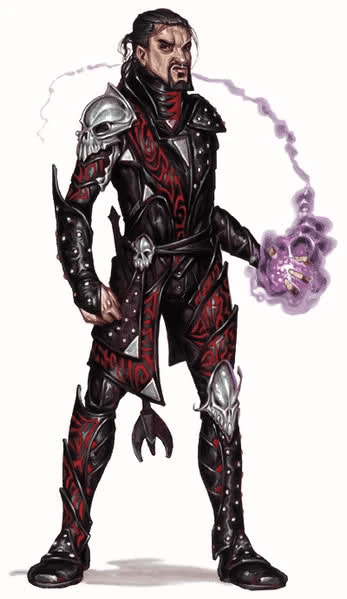
50 Years of D&D: The Warlock
If I had to pick just one design task that left the biggest mark on the game, it would be “creating new character classes.” While I actually worked on a number of ‘em across various editions, two stand out the most: the Sorcerer and the Warlock. I already talked about the sorcerer here. Today it’s the warlock’s turn.
In the early years of 3rd Edition D&D, I generally wore two hats. I was our team lead for the Forgotten Realms product line, and I maintained a half-time schedule as a designer. That suited me just fine, since my first loves are game design and writing. I’m an okay team lead, and I think I helped bring a lot of great products over the finish line. But I’m a better hands-on designer, and the products I directly worked on always got a little more love and attention. For example, the 2004 sourcebook Complete Arcane.
The Complete books were definitely full-on player-focused “crunch” or “splatbooks.” We figured out early in 3e that books aimed at players sold a lot more than books just aimed at GMs. We knew going in that Complete Arcane needed a good array of feats, prestige classes, and spells for arcane characters. But, even more significant, we knew this was an opportunity to publish (or republish) new character classes with an arcane theme.
Two choices were fairly obvious: the wu jen from Oriental Adventures, and the warmage from the Miniatures Handbook. As I developed the outline for the book, I realized I had an idea for a third whole-new arcane class completely unlike anything else we’d ever published. So I got to work on designing the warlock.
Character class design generally originates in one of two ways: story, or mechanics. When you make a story-based class, you think of things that character should be able to do, and then you design the game mechanics to tell that story. The warlock is an example of a mechanic-based idea. I had an idea for how the class mechanics worked, and draped the story elements around that idea.
(Think like a fighter plane designer: You might start by building the best fighter you can around a specific engine, or you might build your fighter and then pick the best engine to fit it.)
My idea for the warlock was simply this. The most important currency for any character is “actions in combat.” In 3e, we felt pretty comfortable about designing toward an expectation of 5 rounds in a typical encounter, and 3-4 encounters in a typical adventuring day. So, you’re going to do 15-20 things a day. Specifically, spellcasters are going to cast at most 20 spells per day. It turns out that by the time a sorcerer or wizard reached 5th level or so, they had enough spell slots to cast all their spells without running out. In other words, a character who could just cast a spell whenever they wanted without tracking spell slots was functionally equivalent to a “regular” spellcaster once you reached the 5th-level “sweet spot” of the D&D game.
Thus the warlock’s eldritch blast was born. If you ever played the Wizard in the old arcade game Gauntlet, you grok eldritch blast: you point at something and blast it with magic.
With that “engine” for the character class figured out, I turned my attention to the story elements that would make the engine really shine. Back in Player’s Option: Spells and Magic, I had fiddled around with a wizard variant using pact magic. People don’t normally blast magic out of their fingertips, so I needed an explanation for how an ordinary mortal could do that without actually casting a spell. Getting that power from a magical patron solved the conundrum—and opened the door for a story reason why the warlock ought to exist in the game world. In fact, it provided a new lens for describing a lot of heroes (and villains) that had been hard to pin down to a character class before.
Anyway, the D&D 3.5e warlock proved popular enough that it was “promoted” to a core class in the 4th Edition Player’s Handbook. While the edition shift meant that the original mechanical idea of the character class was no longer relevant, the story element was strong enough to carry the concept. Eldritch blast was no longer all that unique as an at-will power, but the idea of the pact-powered caster gaining abilities from dark and dangerous entities? That was a keeper.
Likewise, the warlock stuck around for the transition to 5e, too. I’m a little lukewarm on the 5e implementation of the warlock—I’m a little sad to see eldritch blast as just another cantrip. I would have liked to make it a class feature like the rogue’s sneak attack. But it works, and 5e warlocks are certainly fun to play.
What’s the overall impact of the warlock? Pretty big. Hundreds of thousands of players out there have made up warlock characters by now, imagining strange and perilous bargains with supernatural patrons. That’s a pretty satisfying outcome to asking the question, “What if there was a character who could just zot bad guys?”
One more bit of warlock trivia for you: The Star Pact was originally conceived as a mystical tradition based on a sort of “fantastic astrology.” In fact, many of the original power names referred to real-world stars known in antiquity, particularly ones with Arabic names. Thuban, Dziban, Algol, and a couple of others were in the mix in an early draft of the 4e Player’s Handbook. They all fell out of the game, except for one: the Hunger of Hadar (AKA Beta Centauri). Now you know where that comes from!
 Richard Baker
Interestingly, in the just-released Tales of the Valiant (Kobold’s house version of 5e), Eldritch Blast is a warlock class feature, rather than a spell.
LikeLike